









CCLB Editing Notes and Style Guide
CCLB-specific editing notes:
- When referencing CCLB as “the Centre” always use capital “C”.
- When using CLB or NCLC in a text, do not add an “s” (CLBs/NCLCs) to indicate the plural form, the benchmarks are already plural.
- In English, when using the English as a Second Language or English as an Additional Language acronyms in a text, you should write both options together: EAL/ESL.
- In English, when using the initialism “CCLB” to refer to the Centre for Canadian Language Benchmarks, it should be preceded by the article “the”. Tip to help identify appropriate use of the article: If the full name of the organization would include “the”, the initialism will as well.
-
- Examples of when to use the article “the”:
- The CCLB conducted a comprehensive standard-setting study.
- It was the CCLB that hosted the community forum last week.
- The organization that provided the report was the CCLB.
- Some exceptions may occur, for example:
- It seems obvious, but without them, there would be no CCLB.
- Happy anniversary again, CCLB!
- Examples of when to use the article “the”:
- In English the four main skills of ESL are capitalized (Listening, Speaking, Reading, and Writing). If, however, the words appear in reference to the action (of listening, speaking, reading or writing) or the ability in general, then they are not capitalized.
For example:
-
- In general, learners at Stage 2 are listening to and comprehending moderately complex content.
- This is similar for the other receptive skill, Reading, in which Stage 1 learners are reading and comprehending less complex content than those at Stage 2.
- In French, the four main skills of FSL are not capitalized unless they start the sentence (for a title for example).
For example:
-
- La compréhension de l’oral est une habileté réceptive.
- Expression écrite : niveau 8
- The words “benchmark(s)” and “niveau(x)” are sometimes capitalized, depending on the context. When referring to a title or an official name, the word is capitalized. When referring to the generic term meaning a point on a continuum, it is not capitalized.
For example:
-
- When a learner is assigned a benchmark, for example, a Reading Benchmark, the number means that the learner’s reading ability coincides with descriptors for that benchmark.
- Learners at Listening Benchmarks in Stage 1 of the CLB are able to listen to short simple passages and comprehend information that relates to personal needs.
- Les Niveaux de compétence linguistique canadiens reposent sur des concepts et principes théoriques importants.
- Ainsi, les utilisateurs ont accès aux douze niveaux d’une habileté donnée sous un même onglet.
General editing notes:
- Use single spaces between sentences.
- Using numbers in text:
- Write out the word for single digit numbers (0-9).
- Write the numbers in double digits starting with 10.
- Exception: when writing dates, use numbers as you normally do.
- Use the appropriate quotation marks:
-
- In English we use the standard “…”
- In French we use « … » with spaces between the quotation marks and the words inside. The Alt codes for French quotation marks (guillemets) are Alt + 0171 for the opening mark « and Alt + 0187 for the closing mark »
- Avoid using the double apostrophe method.
-
- The CCLB uses the Office québécois de la langue française for appropriate punctuation spacing in French.
Inclusive writing:
- In English, please refer to the Government of Canada’s guidelines around inclusive writing and Gender-based Analysis Plus (GBA Plus).
- In French, please consult the Government of Canada’s guidelines on inclusive writing and gender-based analysis plus (GBA Plus). Epicene writing is the preferred mode of writing at the CCLB. Based on your context and circumstances, use the following EDI recommendations to make your choice:
-
- Preferred: gender-neutral language (écriture épicène), for example, “le personnel instructeur” is the preferred inclusive writing method.
- Accepted: dual gendered terms, like “instructeur et instructrice” or “coordonnatrice et coordonnateur” can be used as an acceptable alternative.
- Only as a last resort: if the first two are challenging to implement, use inclusive writing (écriture inclusive) such as “instructeur·trice” or “apprenant.e.s.”
Additional tools you may want to reference
- Find answers to your questions on grammar, punctuation, spelling and other difficulties of the English language: Writing Tips Plus or French language: Clés de la rédaction.
- Polish your writing skills: Resources of the Language Portal of Canada and Writing Tools / Outils d’aide à la rédaction.
- Create web content: Canada.ca Content Style Guide.
Glossary of CCLB terms
|
English |
French |
|
CCLB Centre for Canadian Language Benchmarks CLB Canadian Language Benchmarks PBLA Portfolio-Based Language Assessment Listening Speaking Reading Writing Stage Benchmark(s) Exemplars Program administrator Multi-level module(s) Language training provider (LTP) Benchmarking Occupational language analysis Cut score Indigenous (Umbrella)* Communities:
|
CNCLC Centre des niveaux de compétence linguistique canadiens NCLC Niveaux de compétence linguistique canadiens ELBP Évaluation linguistique basée sur le portfolio Compréhension de l’oral Expression orale Compréhension de l’écrit Expression écrite Stade Niveau(x) Copies types Responsable de programme Module(s) à niveaux multiples Fournisseur de formation linguistique (FFL) Analyse des exigences linguistiques Analyse linguistique professionnelle Note de passage Autochtones (Umbrella)* Communautés :
|
*To learn more on using the appropriate terminology: https://www.rcaanc-cirnac.gc.ca/fra/1100100013785/1529102490303
Graphic style guide
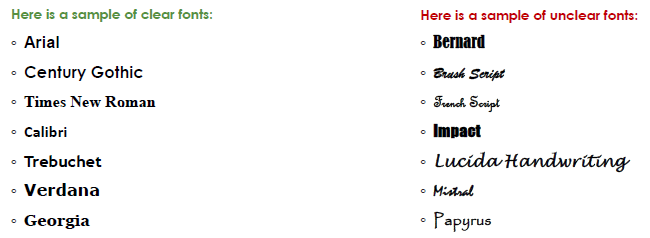
Fonts
Think about readability when choosing fonts; clear distinguishable letters with decent spacing are preferred.
Design colours
|
Colour description |
CMYK (for print) |
Hex # (for digital) |
|
CCLB logo red Dark Blue (Listening) Light Blue Dark Red (Speaking) Light Red Dark Green (Reading) Light Green Dark Orange (Writing) Light Orange Purple (Numeracy) Light Purple Brown (Digital) Light Brown Turquoise (Literacy) Light Turquoise |
0-69-84-19 100-87-22-26 25-10-0-0 25-100-90-35 0-30-9-0 100-40-100-0 17-0-17-0 0-75-100-0 0-17-25-0 60-80-0-0 8-16-0-0 40-65-90-35 10-10-30-0 85-36-28-2 25-0-2-0 |
#cf4022 #1b3564 #b5cceb #861618 #f9b7c3 #0e773c #d3ead6 #ee6223 #fcd3b3 #7c51a1 #e9d8ea #764c29 #e5ddb9 #0b82a0 #bae5f6 |
Logos
The CCLB logos can be emailed to partners/consultants on demand for approved purposes.
- The CCLB has various versions of it’s main logo (alternate colour options; French first options) and come in either PDF, JPG or PNG. When working on French documents, please consider using one of the French first logo.
- The CLB icons (Listening, Speaking, Reading, Writing, Numeracy, Digital, Receptive, Expressive) can also be provided if needed in PDF, JPG or PNG formats.
- Funder logos can also be requested for appropriate uses.
- Alterations to our logos or the funders’ logos are not permitted.